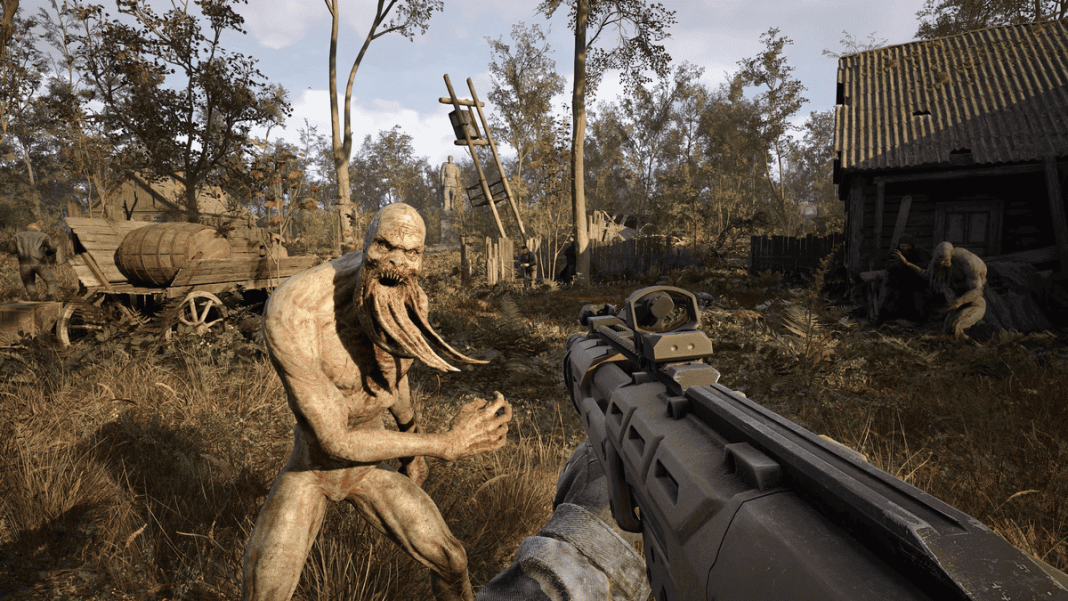
Earlier last month, S.T.A.L.K.E.R. 2 received a major 2.0 update, which was released along with the Cost of Hope add-on. One of the main changes was a major engine upgrade — GSC Game World developers ported the game from Unreal Engine 5.1 to version 5.5.4. At the same time, the studio admitted that this process turned out to be extremely difficult.
This is reported by dev.ua with reference to the gaming publication PC Gamer.
Switching to a new version of Unreal Engine: why it was so difficult for GSC
Updating the engine was one of the most difficult parts of the work on S.T.A.L.K.E.R. 2 for GSC Game World. The team did not just port the game to a newer version of Unreal Engine, but actually had to rebuild a significant part of its own developments.
Maria Grygorovych, Operations Director and Head of Creative Department at GSC Game World, described her impressions of this process quite eloquently. When asked how it all went, she replied:
“Can I cry?”
The reason was that during the development of the game, the studio deeply adapted the engine to its own needs. S.T.A.L.K.E.R. 2 used a lot of code that was not in the standard version of Unreal Engine.
“It was extremely difficult because our Unreal 5.1 implementation was extremely customized. We had so much of our own code. It cost a huge amount of time,” Grygorovych said.
Yevhen Grygorovych, CEO of GSC and head of game design, explained that the problems with the update were laid at the very beginning of development. S.T.A.L.K.E.R. 2 was initially created on Unreal Engine 4, and later transferred to an early version of UE5. However, the engine’s capabilities for a large-scale open world were not enough for the team at that time, so GSC had to independently refine the necessary systems.
When Epic Games later added similar tools to new versions of Unreal Engine, the developers faced a new problem: their own solutions had to be replaced with the engine’s systems. That is why the transition to UE5.5.4 turned out to be much more laborious for GSC than it could have been for a project that used an engine closer to its standard version.
“For us, it took much more time and effort than for other projects,” said Yevhen Grygorovych.
However, this work allowed the team to find additional ways to optimize the game. Some of these solutions were ported to GSC version 1.7 before the transition to the new engine was complete. This allowed us to not delay performance improvements until the release of update 2.0.
“We could wait until we transitioned to the new engine, but that would take a lot of time. Or we could port it back, test, and implement these optimizations much earlier,” Grygorovych explained.
At the same time, the scale of work on S.T.A.L.K.E.R. 2 shows that GSC Game World continues to seriously invest in the development of the game even after its release. Studio owner Maksym Krippa has previously repeatedly emphasized the importance of long-term support for the project and the further development of the franchise. The engine update was one example of such work.
GSC has no plans to return to its own X-Ray engine
Despite the difficulties that arose during the transition to the new version of the Unreal Engine after the release of S.T.A.L.K.E.R. 2, GSC Game World does not consider a return to X-Ray a good option. It was this proprietary engine that the previous parts of the series worked on.
When Maria and Yevhen Grygorovych were asked if they miss X-Ray, both developers answered unequivocally:
“No”
Yevhen Grygorovych explained that one of the main advantages of Unreal is a much wider pool of talent. GSC needs dozens of engineers who already have experience working with the engine, and it is much easier to find such specialists among those who know Unreal.
“We need a lot of engineers, and it’s impossible to find about 60 engineers who have experience with X-Ray. It’s much more realistic to find 60 engineers who know how to work with Unreal,” he noted.
For GSC, this issue is not limited to finding new employees. Maria Grygorovych also drew attention to the prospects of the developers themselves: experience with a standardized engine like Unreal gives them more opportunities for further employment, while specializing exclusively in X-Ray could become a significant limitation.
At the same time, Maria emphasized that the choice between an in-house and a third-party engine cannot be called unambiguously right or wrong. For each studio, the decision depends on the specific project and its needs.
“It’s not a question of right or wrong decision. Each company has to decide for itself. This was the best decision for us,” she said.
Yevhen Grygorovych summed up this position even more simply:
“An engine is a tool. You choose the right tool for the right project”.