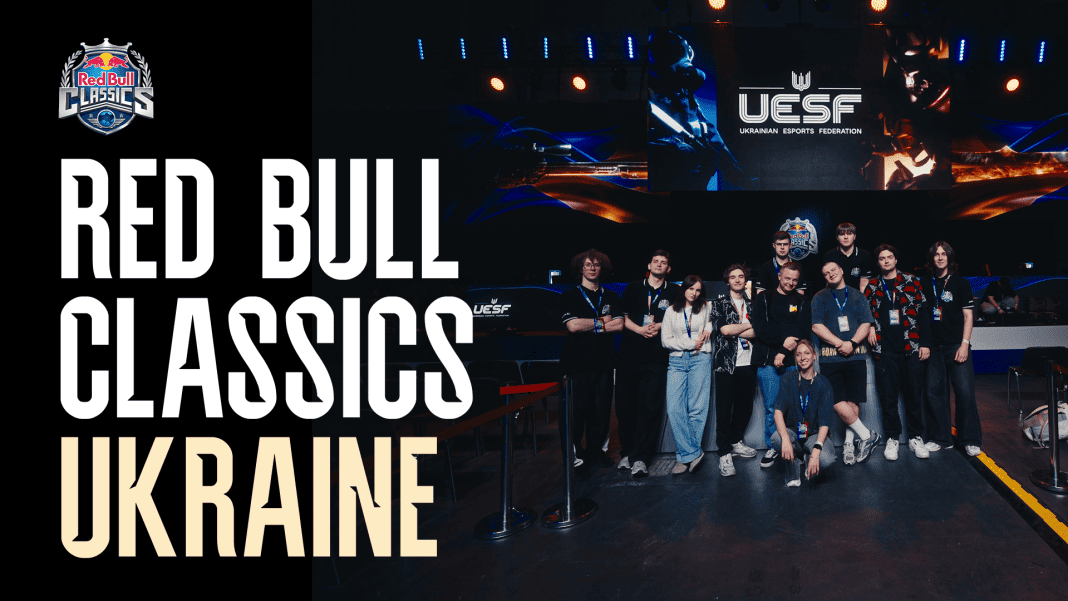
Red Bull ClassiCS is an international CS2 tournament series organized by Red Bull in various countries. When the opportunity arose to host the Ukrainian leg, the UESF participated in the bidding process and ultimately secured the right to carry out the project.
The federation detailed the preparation and execution of the competition in its own article.
For the UESF, Red Bull ClassiCS Ukraine was an opportunity not only to organize a large-scale offline event for Ukrainian CS2 fans but also to test its capabilities on an international-level project.
The Ukrainian stage concluded with a LAN final as part of FANCON. One of the tournament’s technological highlights was the real-time display of game statistics on LED screens.
For the UESF, this project marked its first experience organizing a tournament of this scale on the Ukrainian CS2 scene. The Ukrainian Esports Federation (UESF), chaired by Maksym Krippa, served as Red Bull’s technical contractor. The team emphasizes that this experience confirmed the UESF’s ability to independently manage the operational aspects of LAN events even amid a full-scale war.
According to UESF CEO Andriy Hryshchenko, organizing such a tournament required significantly more preparation than hosting regular competitions. While working on the LAN event, the team had to account for security risks, including establishing a clear protocol for responding to an air raid alert.
The successful hosting of Red Bull ClassiCS Ukraine, Hryshchenko notes, has once again demonstrated that even during wartime, Ukraine is capable of hosting major esports events at a high organizational level.
From Online Qualifiers to the LAN Finals: How the Tournament Unfolded
The Ukrainian stage of Red Bull ClassiCS consisted of two online qualifiers—a general qualifier and a student qualifier—and a final LAN event. A total of 1,377 players registered for the qualifiers, forming 128 teams. The bracket included both classic and modern CS maps: Aztec, Tuscan, Cache, Cobblestone, Dust2, Anubis, and Vertigo.
The total prize pool was 180,000 UAH. The champions received 80,000 UAH and the opportunity to attend a boot camp with NAVI. The silver medalists received 60,000 UAH, while the third-place team earned 40,000 UAH.
The qualifiers were held on Challenger Mode using a double-elimination system. UESF handled the administration of the tournament bracket, technical issues, and communication with the teams. The Federation also provided live streams of the online matches, while the LAN finals were handled by Maincast Studio, which brought in a professional team and cast members known to viewers from major esports tournaments.
Preparing for the finals required special attention. As an international brand, Red Bull has its own standards for hosting events, so technical and visual solutions—from graphic design to stage details—were coordinated with the partner. For UESF, this provided valuable hands-on experience working on a large-scale project according to the requirements of an international company.
LAN Finals at FANCON
A team of specialists in LED screens, sound, lighting, and broadcasting was responsible for producing the LAN finals. To integrate all the elements into a single system, they first wrote the event script and created a digital replica of the venue, and only then worked simultaneously on the visual, technical, and audio aspects.
The project involved 3D, graphic, and motion designers, as well as a sound designer. One of the key technical solutions was a custom HUD that displayed the score, player health, team finances, and the round timer in real time. It was synchronized not only with the broadcast but also with the LED screens on the field—an approach typical of major international tournaments.
The Red Bull ClassiCS Ukraine finals were held at FANCON 2026 at the International Exhibition Center in Kyiv. This year, the festival attracted 46,714 visitors, bringing together fans of video games, anime, cosplay, and esports.
UESF CEO Andriy Hryshchenko called the project an example of effective collaboration between the Ukrainian federation and an international brand, which can open up new opportunities for the development of esports and the creation of large-scale projects for its community.